Walking Between Memory and Possibility: My Journey to Israel with the Merrin Teen Professional Cohort
In January, Federation Camp, Youth & Family Engagement Manager Stefanie Shapiro participated in an intensive seminar in Israel. The seminar was part of Stefanie’s participation in the Merrin Teen Professional Fellowship, a program from JCCA designed for JCC professionals who work directly with teenagers. We asked Stefanie to share her experiences, which you can read below.
Sitting around the table at Goshan in Tel Aviv on our first night in Israel, our group began framing what this trip would really be about. Israel, we were told, is three things at once: a holy land, a modern country, and the Third Jewish Commonwealth (only the third time in history that Jews can govern themselves freely). Beyond geography and politics, we explored a deeper definition of history: not just what happened, but the memories and experiences that shape our next decisions. That idea stayed with me throughout the entire trip.
From Sand Dunes to Start-Up Nation
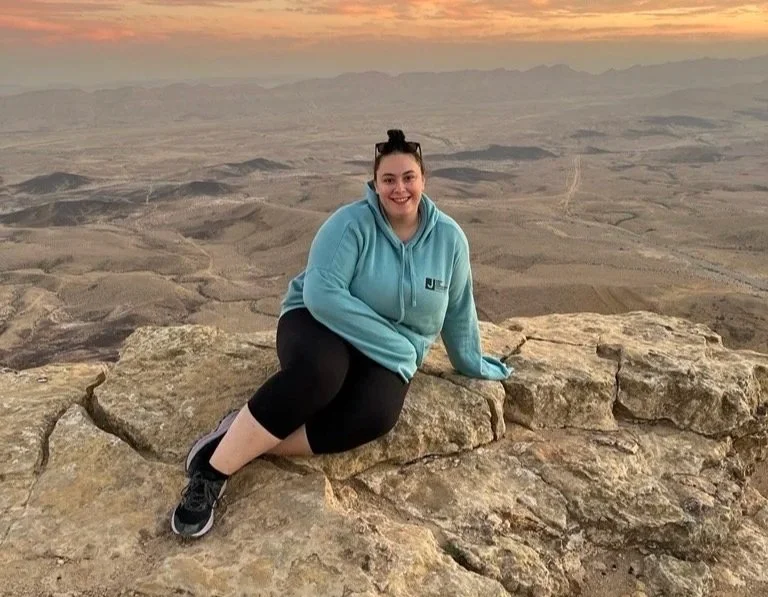
We began with a walking tour of Tel Aviv, a city literally born from sand dunes in 1909 when sixty families left Jaffa to build something radically new. Their dream was a modern Jewish city like “the New York of the Middle East.” As Shimon Peres once said, “Tel Aviv is the first start-up.” Not because of tech, but because it represented the courage to change reality without abandoning dreams.
In neighborhoods like Neve Tzedek, we learned how early Zionists pushed back against old-world rabbinic Judaism and reimagined it as a national identity, not just a religion. They built schools for girls, playgrounds where boys and girls played together, and cultural institutions similar to modern-day JCCs instead of just synagogues.
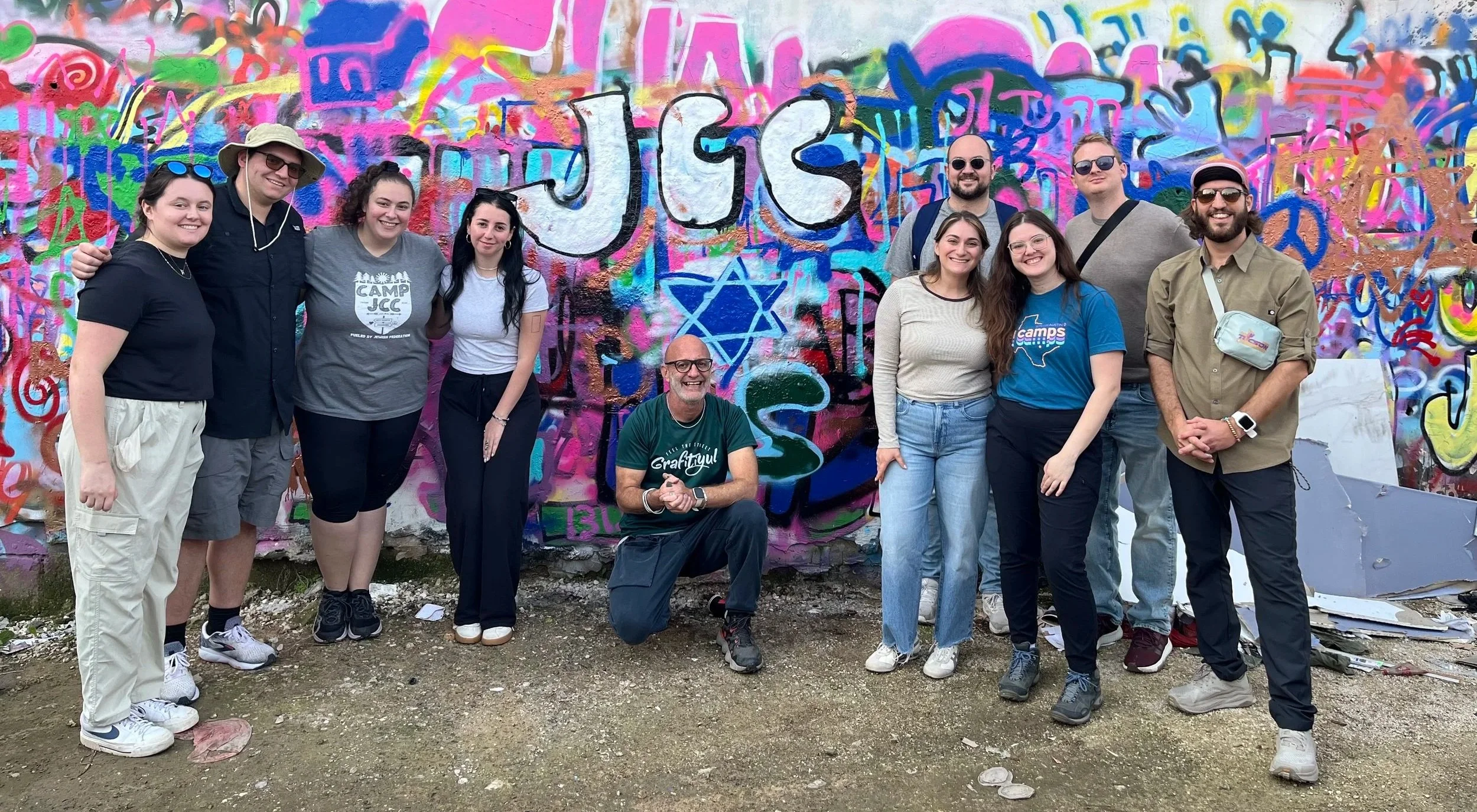
Later, on a graffiti tour of Tel Aviv, we saw how that same spirit lives today. After October 7, artists transformed walls into spaces of hope and storytelling. The “Walls of Hope” depicted who the hostages are, not just as a memorial. Murals around the city honored heroes like the female border observers who warned something was wrong before anyone listened or those who stood up to defend their kibbutzim. In Israel, art isn’t decoration, it’s memory in public space.
Desert Lessons and Community in Yerucham
On Day Three, we hiked through Ein Avdat, walking paths the Israelites once traveled before entering the land. We learned that the Torah was given in the desert so it would belong to everyone. A people born in the desert is a people born of the ten commandments, representing responsibility and morality.
From there we visited Paula and David Ben-Gurion’s graves, watched sunset over Maktesh Gadol, and ended the day at Machsan 52 Community Center in Yerucham. Yerucham is a low-socioeconomic city, yet Machsan 52 is its heartbeat for youth. With just two full-time staff, shin-shin volunteers, and teen councils, they serve as the main gathering space for local kids through music, theater, and leadership programs. What struck me most was how youth voice drives the center: teens decide programming, organize activities, and shape their own community. It was reminder that Jewish community building looks different everywhere, but the values remain the same.
Holding Space for At-Risk Youth
Another powerful stop was Shanti House, which supports at-risk youth ages 14–21 in Tel Aviv, Jerusalem, and the desert. Serving up to fifty teens at a time in its desert location, Shanti provides structure, safety, education, therapy, and dignity. Youth arrive from tough times and have the chance to experience the fun of life again. They receive support not from pity, but from belief in their potential. What moved me was their philosophy that staff aren’t there to feel sorry for kids; they’re there to walk alongside them. Many counselors are Shanti graduates themselves. From therapeutic surfing to summer programs, Shanti helps teens rebuild themselves, instead of rescuing them.
October 7: Memory in Real Time
Visiting the site of the Nova Music Festival, October 7 became real, not just a date. We read stories, saw faces, and learned how Hamas not only attacked the festival but also ambushed cars along Road 232. At another memorial, destroyed vehicles told silent stories, like a pile of shoes at a Holocaust memorial. Each of us chose someone who died, learned their story, and shared it aloud. Then we said the Mourner’s Kaddish together. It was one of the most emotional moments of the trip and collective memory became collective responsibility.
Later, we met with a leader from Tireinu, an organization working to help young adults repopulate and rebuild southern kibbutzim after October 7. After a day full of grief, Tireinu offered opportunities for hope and action.
Jewish Peoplehood and Shared Society
At ANU, the Museum of the Jewish People, we explored Jewish identity from ancient times to modern pop culture. We saw exhibits on music, humor, food, film, art, and activism. Anu told us that Judaism is not only land and space, but time and values that pass through generations.
We also visited an Arab-Israeli Community Center in Jaffa, where we met Vera, a Christian Arab Palestinian Israeli. Her story was complicated and human. She spoke about living between identities, gentrification, language barriers, and community responsibility. What stayed with me most was her belief that change starts locally, and people build trust long before governments do. She explained that education, relationships, and daily cooperation are what allow a shared city like Jaffa to function at all. It was one of the most honest conversations of the trip and led to meaningful discussion within our cohort afterwards.
Shlichim, Healing, and Global Responsibility
One especially meaningful moment for me was reconnecting with Ola and Viola, our camp shlichim from summer 2025, over Shabbat coffee and a walk along the Tel Aviv beach. Seeing familiar faces from camp in Israel blended my professional world at home and the living reality of Israel. It reminded me that through camp and connections, Israel isn’t abstract for our youth and teens; it becomes personal, relational, and very real.
At Save a Child’s Heart, we saw what global Jewish responsibility looks like in action. The organization brings children from over 75 countries to Israel for life-saving cardiac procedures, free of charge. Families live in a shared home while kids rotate between the hospital and programming. Caregivers cook meals from their home cultures, volunteers run activities, doctors train professionals to take skills back to their countries. It’s truly a community partnership. Over 8,000 children’s lives have been transformed there, and each one carries Israel back to the world with them.
Youth, Teen, and Young Adult Leadership in Action
We met teens at Beit Israel Mechina, a pre-army gap-year program and discussed identity, responsibility, and Israeli teens’ connection to diaspora Jews. At Krembo Wings, youth with and without disabilities lead programs together, not as caretakers, but as friends. With over 8,000 active members, they truly live their motto of “Youth Leading Youth”.
Our visit to Ma’aleh School of Television, Film, and the Arts showed how Israeli college students use storytelling to explore real dilemmas like checkpoints, social belonging, culture clashes, and humor. Their films embraced the complexity of life in Israel and told very real stories of the people who live there.
Jerusalem: Sacred Space and Shared Stories
In Jerusalem, everything felt like ascent. We studied why this city matters so deeply to Judaism, Christianity, and Islam by standing at the Western Wall, inside the Church of the Holy Sepulcher, and near the Dome of the Rock. We explored how one small hill carries three spiritual universes. Seeing the three holy sites side by side made it impossible to reduce Jerusalem to one narrative. Faith, power, longing, and identity are layered on the same stones.
From the Broad Wall of King Hezekiah to the Old City quarters, we learned how survival, empire, and religion shaped the city. It is the story of history and modernity woven together. We ended at the National Library of Israel, a “well of knowledge” holding over five million books, which reminds us that ideas, culture, and education are as powerful as borders. The library is open to all as a place of learning and gathering.
The West Bank: Complexity Without Easy Answers
Our day in the West Bank was about understanding complexity, not solving it. We learned about Zones A, B, and C from the Oslo Accords and what it means for daily life, governance, and identity. We talked openly about the tension between Israel being Jewish, secure, and democratic, and how difficult it is for the three to coexist at once.
We visited Qasr el Yehud, Jesus's baptismal site and the Isreali-Jordan border on the Jordan River. Waving to the people just across the way, visting the same site we were over in Jordan, reminded me why peace is so important on a human level. While borders may be political, humans can have similar experiences no matter what country they are in. Later we toured Psagot Winery and created a musical percussion circle at a Canaanite restaurant. The day wasn’t about choosing sides or soliving problems. It was about seeing the human, political, and geographic layers that make this conflict so enduring and so emotional.
Yad Vashem: Memory as Responsibility
At Yad Vashem, Israel’s Holocaust memorial, memory resurfaced as the central theme of the trip. While we remembered what happened during this horrific time, we confronted the dilemmas Jews faced: trade family heirlooms for food, risk your child’s life to sneak outside a ghetto, or hold onto dignity when survival itself is uncertain. We talked about how the generation that survived often stayed silent, and how the next generation insisted that this happened to the Jews. It must be remembered actively, not passively. Walking through Yad Vashem reframed everything else we had seen. Israel isn’t only a state, it’s a response to memory, trauma, courage, and the refusal to let others write Jewish history for us.
Final Reflections
Traveling with the Merrin Teen Professional Cohort wasn’t just about seeing Israel. It was about understanding how land, culture, youth work, and memory intersect. Of the many things I took with me, two stand out. First, youth work is nation building. Whether at Shanti House, Krembo Wings, Save a Child’s Heart, or home here in Raleigh, youth and teens aren’t just being impacted. They are being trusted, empowered, and shaped into leaders of a complicated future. Second, a JCC is not a building, it’s a values engine. Machsan 52, Arab-Israeli community centers, and even graffiti walls function as places where identity is practiced, not preached. We must continue to create spaces for our youth and teens to figure out who they want to be and how they want to impact the world.
Israel lives in tension: history and hope, grief and creativity, survival and rebuilding. Walking between those spaces reminded me why investing in our future isn’t optional; it’s how people decide who they become next. After this journey, I’m more certain than ever: the future of Jewish community, in Israel and the diaspora, is already being written by our youth and teens.